

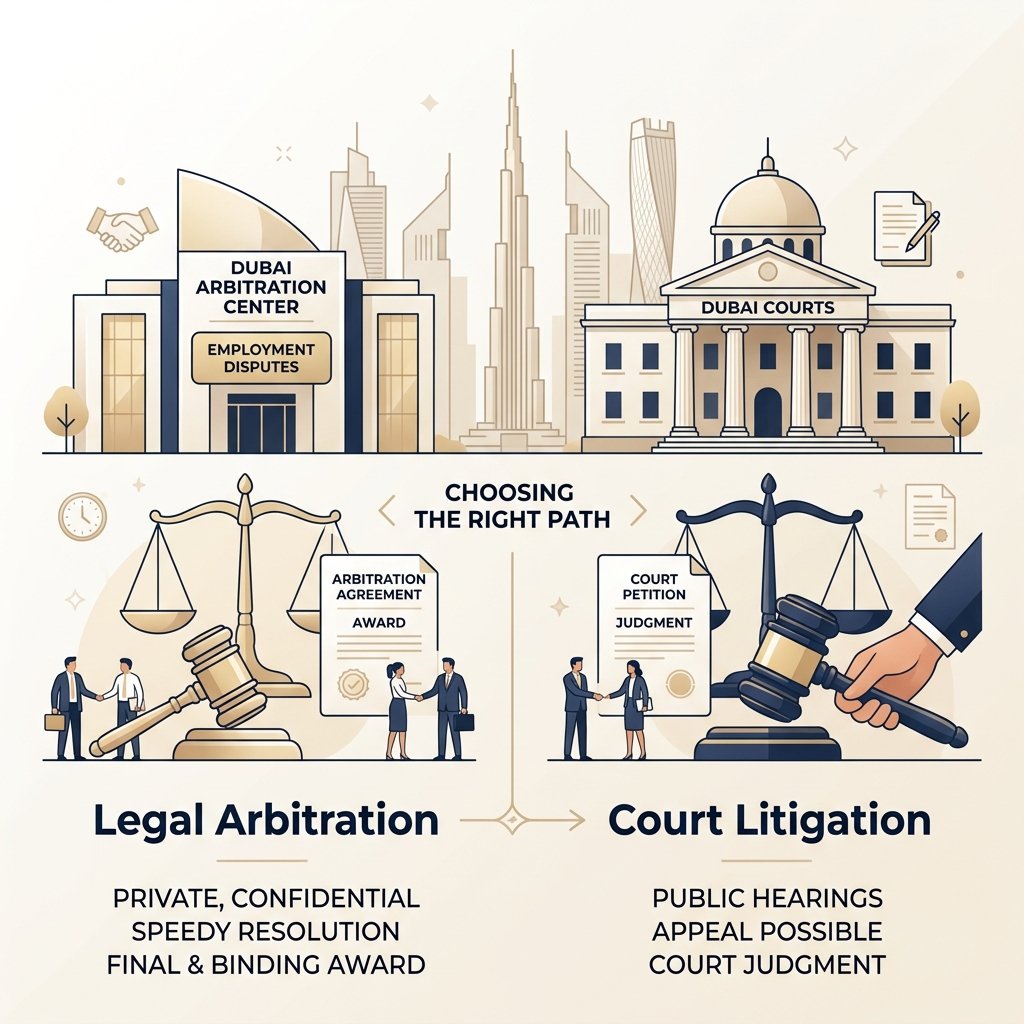
Arbitration vs Dubai Courts for Employment Disputes: What You Need to Know
When workplace conflicts escalate in the United Arab Emirates, choosing the correct forum for dispute resolution is critical to securing a prompt, legally binding outcome. Under UAE law, private sector labor disputes are generally resolved through statutory administrative procedures followed by litigation before the specialized Dubai Labour Courts. However, in international jurisdictions, corporate leadership, and specialized financial hubs like the Dubai International Financial Centre (DIFC), alternative dispute resolution options—such as commercial arbitration—are often evaluated. Understanding the distinction between labor litigation and employment arbitration in Dubai is essential for both employers and employees facing contractual breaches, executive disputes, or compensation claims.
Dubai Labour Courts: The Primary Statutory Pathway
For mainland entities and most UAE free zones, the resolution of labor conflicts strictly follows the framework established by UAE Federal Decree-Law No. 33 of 2021. The statutory litigation procedure offers a structured, regulatory path for claims involving salaries, termination payments, and end-of-service gratuity:
- Mandatory MOHRE Mediation: Before filing a lawsuit in court, an aggrieved party must submit a formal complaint to the Ministry of Human Resources and Emiratisation (MOHRE). MOHRE acts as an administrative mediator to facilitate an amicable settlement.
- Statutory Referral: If MOHRE cannot settle the dispute amicably within 14 days, the dispute is formally transferred to the Dubai Labour Courts via an official referral letter.
- Public and Binding Proceedings: Dubai Courts operate in Arabic, applying UAE statutory law. Court judgements are publicly binding and enforceable directly through local execution channels.
- Exemption from Court Fees: To maintain access to justice, employees claiming amounts under AED 100,000 are generally exempt from court fees at all stages of litigation.
Employment Arbitration in Dubai: Legal Feasibility & Context
While commercial contracts frequently feature arbitration clauses, standard employment disputes in mainland UAE cannot bypass MOHRE or the Dubai Labour Courts. UAE labor policy treats employee statutory rights as matters of public order, meaning pre-dispute arbitration agreements in standard mainland employment contracts are generally unenforceable in lieu of statutory court jurisdiction.
However, arbitration plays a strategic role under specific high-level circumstances:
- Senior Executive & Shareholder Agreements: Executives who hold dual roles (such as shareholder agreements, equity options, or corporate directorship contracts) can submit non-statutory commercial claims to private arbitration through institutions like the Dubai International Arbitration Centre (DIAC).
- Post-Dispute Submission: Once a dispute has arisen, parties may mutually agree to submit complex commercial aspects of their separation to binding arbitration, provided statutory labor protections are preserved.
- Confidentiality Benefits: Unlike public court proceedings, arbitration guarantees complete privacy, protecting sensitive corporate intellectual property, executive reputation, and severance figures.
DIFC Courts: Common Law Framework for Financial Free Zone Disputes
The Dubai International Financial Centre operates an entirely independent legal jurisdiction based on English common law, governed by DIFC Law No. 2 of 2019. Entities registered within the DIFC fall outside MOHRE's statutory jurisdiction, utilizing a distinct dispute pathway:
- Small Claims Tribunal (SCT): Employment claims valued under AED 500,000 are initially heard by the DIFC Small Claims Tribunal. The SCT emphasizes swift conciliation and confidential resolution, typically delivering determinations within weeks.
- Court of First Instance (CFI): Complex executive claims exceeding AED 500,000 are escalated to the Court of First Instance. Under practice rules, CFI employment proceedings maintain default confidentiality and a presumption that each party bears its own legal costs.
- English-Language Advocacy: Proceedings are conducted entirely in English, making it the preferred jurisdiction for international financial institutions and multinational corporations. Engaging specialized DIFC employment lawyers is critical for navigating DIFC Court procedural rules and statutory remedies.
Key Factors When Evaluating Your Dispute Strategy
Determining whether to litigate in local courts or pursue institutional dispute mechanisms requires evaluating several key considerations:
- Jurisdictional Validity: Attempting to enforce an arbitration clause in standard mainland labor contracts will lead to jurisdictional dismissals. Retaining an experienced labor court lawyer in Dubai ensures your claim is filed in the appropriate forum from the outset.
- Cost & Efficiency: While MOHRE and Dubai Labour Court litigation is cost-effective for standard statutory claims, executive arbitration and DIFC CFI proceedings involve administrative fees and legal representation costs proportionate to complex commercial claims.
- Enforceability: Dubai Labour Court judgments execute directly on mainland corporate assets and bank accounts, whereas arbitral awards require formal ratification prior to execution.
Whether navigating complex statutory litigation before the Dubai Courts or managing executive separation agreements, seeking early guidance from qualified labor dispute resolution specialists prevents costly procedural errors and protects contractual rights.
Consult an Employment Lawyer in Dubai
Selecting the correct venue and formulating an effective litigation or settlement strategy is crucial when resolving workplace disputes. Alqada Law Firm provides complete advocacy before MOHRE, Dubai Labour Courts, and specialized free zone tribunals. Speak directly with our team today through our legal consultancy services or visit our Contact Alqada Law Firm page to schedule a confidential legal assessment.